The player market and prices
The city covers the basics; the best goods are made and sold by players — at prices set by real deals.
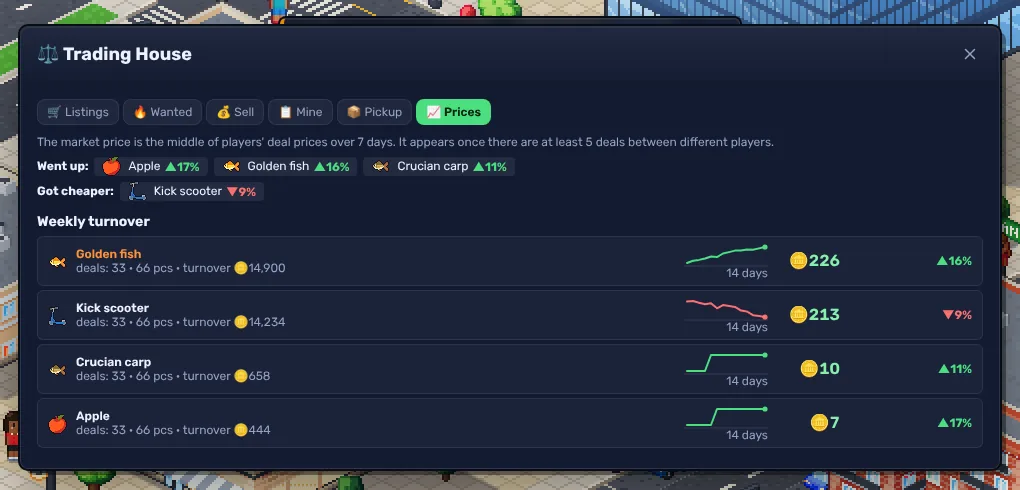
The Towneers economy follows one rule: the city covers the basics, and the best goods are made and sold by players. The city always buys from players a little cheaper than players usually pay each other (the “floor”), so quality goods, rare fish, ★★★ crops and crafted furniture are worth selling to people — in the Trading House or in your own shop.
Where players trade
| Place | How it works |
|---|---|
| Trading House | put items up as lots or post “buy” orders; the city takes a 5% fee on a sale |
| Your own shop | quality items (★★/★★★, with the maker's signature) and your own dishes on the shelves |
| Buy orders in your place | “we buy X for 🪙Y” — up to twice the reference price for rare goods |
| Direct trade | swap items and gold with another player face to face |
How a price is formed
Nobody sets prices by decree. Every Trading House purchase, “buy” order and sale to a player's shop is recorded; the item price is the middle of recent deals. Until there are enough deals, the reference is the retail price adjusted for quality. The item card shows “players usually pay ≈” and where the item is on sale right now.
Quality matters
Crafted goods and crops come in ★, ★★ and ★★★. Higher quality sells for more, both to players and to cafés that order ★★/★★★ produce. That is why skill in a craft pays off.
Selling property works the same way: the city pays 70% of the value, a player pays what you agree on.
Numbers on this page come straight from the game data and change with it. Towneers is in alpha: balance can change and the world may be reset.