Teams and factories in Towneers: build a production chain with friends
Found a team, rent a hall in the Industrial Zone, install machines together and turn logs, flour or leather into goods. Real prices, roles, shares and a step-by-step plan.
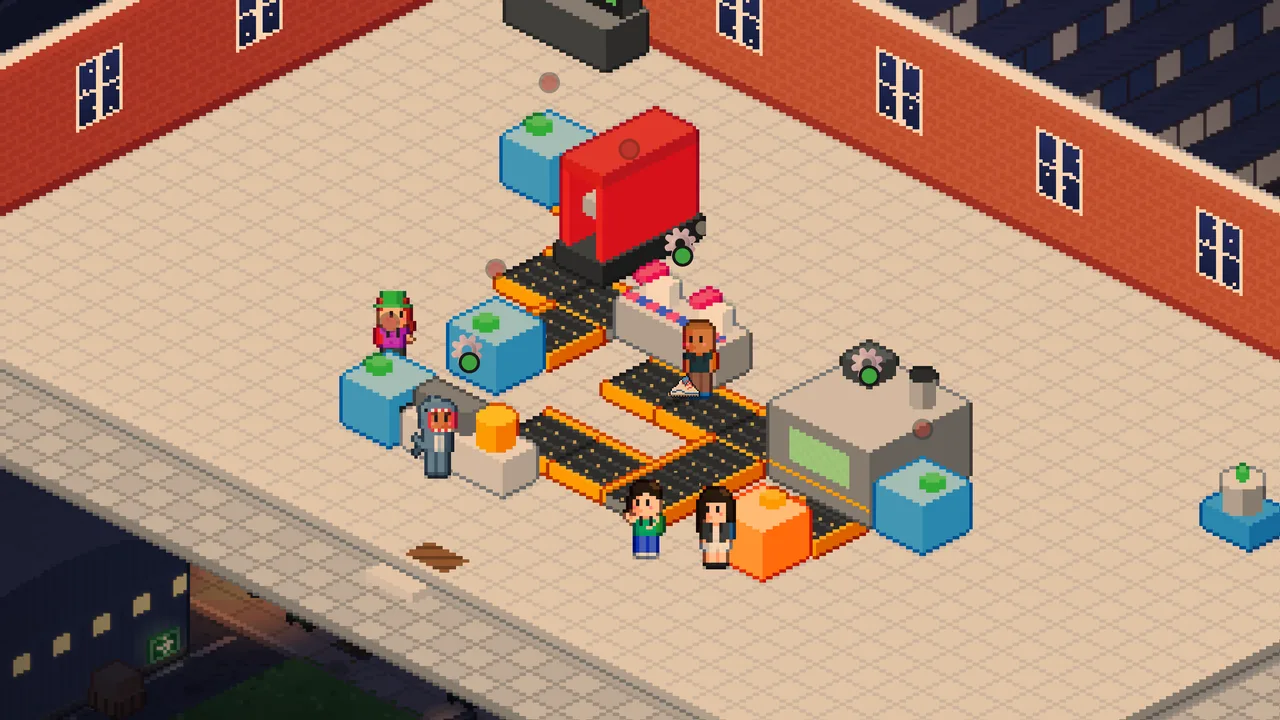
In Towneers a team of friends can rent a factory hall in the Industrial Zone, install machines and conveyor belts together, and turn raw materials into bread, furniture or sneakers that the city and other players buy. It is the deepest part of this free multiplayer pixel city, and it works as a small business sim in the browser: costs, wages, shares, payouts. The whole thing can also be run by a team of one.
This guide goes deeper than business and places and how to open a café. For the story behind the mechanics, read the player economy post. Every number below comes from the game's current settings, and the game is in alpha, so they may change.
Step 1. Found a team
A team is a permanent company of players, up to 30 people: a tag over everyone's head, a Team tab in the chat, a treasury and a place in the city's team ranking. A party, by contrast, lasts only one session.
- Cost and level: 🪙1,000 and level 3. You choose a name, a tag of 2–4 characters and a colour.
- Where: 👥 Friends → Team, the Team app on the phone, or City Hall → Teams of the city.
- Inviting: the leader invites friends from the team window or a player's menu. A friend who has not started playing yet can be invited by a link and finds the invitation waiting.
- Treasury: anyone can pay in (from level 3 or after a day of play), only the leader withdraws.
Founding is the easy part. A team of friends who chat every evening in a social multiplayer online game like this one is the real asset: a factory needs people who come back.
Step 2. Rent or buy a factory hall
The leader goes to a warehouse with the FACTORY sign in the Industrial Zone and presses 🏭 Rent on its card. One team can have one factory, and it is paid in gold only.
| Workshop hall | Factory hall | |
|---|---|---|
| Size | 14×10 tiles | 20×12 tiles |
| Power input | 20 kW | 45 kW |
| Rent | 🪙150 per game day | 🪙350 per game day |
| Buy outright | 🪙18,000 | 🪙45,000 |
| Warehouse | 2,000 | 5,000 |
| Transformers | 1 | 2 |
Rent is taken from the factory cash box, not from your pocket. If the cash box stays empty for three days in a row, the hall returns to the city, so keep a reserve of at least three days of rent. Start with the Workshop hall: it fits a whole chain of 4 to 9 machines.
Step 3. Roles, shares and the cash box
The team owner (the leader) assigns roles in the 👥 Team tab of the factory window. New members start as Workers.
| Role | What they can do |
|---|---|
| 👷 Worker | Put materials in, install, switch machines on and off, take goods from the warehouse |
| 📐 Engineer | Everything above, plus build and configure machines and recipes |
| 🧭 Manager | Everything above, plus spend from the cash box, remove machines, set delivery prices |
| 👑 Owner | Everything above, plus roles and payouts |
The cash box receives money for deliveries to the city and for goods taken from the warehouse. It pays rent, electricity, the shift master's wage and construction purchases. A Manager can withdraw up to 🪙2,000 per game day, and the Owner gets a notification.
Shares and activity. Everything you put in earns permanent shares: gold counts one to one, a machine as an item counts at 40% of its catalogue price, materials at wholesale price, and one installation point counts as 🪙15. Shares stay with you even if you leave the team; the team can buy them out at book value (half the value if a member is expelled for sabotage). On top of that, weekly work (installing, tuning recipes, adding raw materials) gives activity points. Someone who has not logged in for a while is paid by shares only.
Payout. The Owner picks an amount from the cash box above the reserve and a rule: 50/50 between shares and activity (the default), 70/30, 30/70 or everything by shares. The screen shows who gets how much. A payout over 🪙10,000 waits for a second signature from the Manager, if there is one, and the 📜 Log records who put in, took out and was paid.
Step 4. Power, air and the first machines
Every machine is an item: a mechanic crafts it (a carpenter makes the crate), or you can buy it from the city turnkey, which is more expensive. Machines in the factory work at about a craftsman's speed, so the factory wins by having many machines and by working without people at the controls.
Electricity costs 🪙0.5 per kW per game hour. Machines draw different power:
| Machine | Power | Does |
|---|---|---|
| Sawmill | 3 kW | log → planks |
| Loom | 3 kW | cotton → fabric |
| Mill | 2 kW | wheat → flour |
| Dough mixer | 3 kW | flour, eggs, milk → dough |
| Tunnel oven | 4 kW | dough → bread |
| Sandwich line | 2 kW | bread, cheese, tomato → sandwiches |
| Sewing line | 2 kW | blanks and fabric → shoe uppers |
| Press | 4 kW + air | leather → upper blanks |
| Injection press | 5 kW + air | plastic → soles |
| Assembler | 6 kW | furniture, sneakers |
Presses need compressed air from a compressor (5 kW, 1,800 catalogue price). If power or air runs short, every machine slows down. A transformer adds 15 kW (2,500 catalogue price). Lamps above machines tell you the state: green works, yellow has no raw materials, red is a jam or a lack of power or air. Now and then a machine jams, and any member can fix it with a master-moment ring.
Step 5. Install by hand, together
In the factory, press 🛠️ Build, pick a machine or belt and place it. This lays down a construction site. The site needs the object itself, an installation kit (metal, fittings, wire) and manual work. Press 🔨 Installation and hit the master moment: a perfect hit gives 2 points, otherwise 1. A belt is placed at once, a machine needs 3 to 8 points. Several people on one site work together, so two friends install twice as fast, and everything you put in becomes your contribution.
At the bottom of the build panel, 📦 Put in from the bag and 🪙 Buy the missing serve all sites at once. If you are in a hurry, 👷 Crew finishes the remaining points right away at 💎2 per point, but never more than half of the site's points, and it does not count toward anyone's contribution. Gems are optional: every route in the factory works with gold and time alone.
Step 6. Build the chain
An intake dock takes chosen materials from the factory warehouse onto a belt (60 items per game hour per belt). A machine makes a batch by its recipe and puts the result back on the belt, and an output dock puts finished goods into the warehouse. A splitter divides a belt between two outputs, and a buffer crate holds up to 200 items. Click a machine to pick its recipe and mode: Always, Keep N in stock or Off.
Real chains from the game:
Bread and sandwiches (11 kW, fits the Workshop hall):
- Mixer: 2 flour + 1 egg + 1 milk → 3 dough in 20 minutes.
- Tunnel oven: 2 dough → 3 bread in 30 minutes.
- Sandwich line: 1 bread + 1 cheese + 1 tomato → 3 sandwiches in 20 minutes.
The mill (2 wheat → 3 flour) can sit at the start. City grocery stores and bakeries take bread and sandwiches.
Furniture: the sawmill turns 1 log into 3 planks in 30 minutes, and the assembler builds chairs, tables, armchairs and sofas by the carpenter's recipes. A chair costs about 🪙3 in materials against a wholesale price of 🪙19.
Sneakers (the hardest chain):
- Press: 1 leather → 4 upper blanks (needs air).
- Injection press: 1 plastic → 2 soles (needs air).
- Sewing line: 2 blanks + 1 fabric → 2 shoe uppers in 20 minutes.
- Assembler: 2 uppers + 2 soles + 1 fittings → a pair of sneakers in 24 minutes, with the colour set in the machine's mode.
This one draws about 17 kW from the machines, plus the 5 kW compressor, so on a Workshop hall plan a transformer.
- Log
- Planks
- Flour
- Dough
- Bread
- Sandwich
Recipe tuning. A recipe with a skill requirement is tuned once by a member who has the skill, for example tailoring 80 for sneakers, cooking 15 for dough. The tuning stays with the factory, and the member's skill grows.
Step 7. Staff and shifts
A factory with nobody inside works for 4 game hours after the last member leaves. A resident operator hired through Candidates keeps it running for up to 12 game hours; the shift master's wage is 🪙14 per game hour from the cash box. So the usual rhythm is: a few members set the machines up in the evening, a hired master keeps them going through the night. Residents of the city take the job: you choose a candidate and offer a rate.
Step 8. Sell the output
- City deliveries (🚚 Sales tab). When city shops refill their shelves, they take up to 60% of the order from factories, at your price, but not above 90% of wholesale. The money goes to the cash box.
- Take for yourself. Members take goods from the warehouse at wholesale price, for themselves, for their own venue or for the Trade House. Workers and Engineers have a daily quota of 🪙300.
- Players. List goods in the Trade House, where players usually pay more than the city.
- Buy orders. A member who runs a café can post a buy order in Manage → Storage → Buying from players; sellers use 💵 Sell at the till, and the venue's cash register pays. A factory member's café can buy its own team's bread this way.
- Bigger orders. Higher factory levels open large city orders and exports. You earn a level by certifying at the control desk: deliver a batch to the city and pay a fee. A level also opens new machines: canning, packaging, lathe and autoclave.
A step-by-step plan
| Stage | What to do | Result |
|---|---|---|
| 1 | Gather 2–3 friends and found a team (level 3, 🪙1,000) | Tag, Team chat, treasury |
| 2 | Pay into the treasury, rent the Workshop hall | Hall with 20 kW and a cash box |
| 3 | Assign roles: a Manager for money, Engineers for building | Clear rights |
| 4 | Craft or buy a mixer, oven and sandwich line, install them together | First machines, first shares |
| 5 | Add intake and output docks and belts, set recipes | A working chain |
| 6 | Fill the warehouse with raw materials from farms and shops | Machines start |
| 7 | Set delivery prices, hire a shift master | Income at night too |
| 8 | After a week, pay out by the default 50/50 rule | Money to everyone |
Typical mistakes
- An empty cash box. Rent and power come from it; keep three days of rent in reserve.
- Too many machines for the power. Check the load before you place the sneaker line; add a transformer first.
- Forgetting air. Presses without a compressor stand still.
- One person does everything. Shares and activity reward everyone, so spread the roles.
- No raw-material plan. A factory is only as good as its supply; agree who farms, who fishes and who buys.
For a place to live and a plot of your own, see the plot and house guide.
Questions and answers
How do I create a team in Towneers?
Reach level 3 and pay 🪙1,000. Open 👥 Friends → Team, enter a name, a 2–4 character tag and a colour, then invite friends.
How many players fit in a team?
Up to 30 members. The team has its own chat tab, treasury and a city ranking.
How much does a factory cost?
The Workshop hall rents for 🪙150 per game day or costs 🪙18,000 to own. The bigger Factory hall is 🪙350 per day or 🪙45,000. Only gold is accepted.
Can I run a factory alone?
Yes, a team can have a single member. But rent, power and building are easier to carry together.
What happens if I leave the team?
Your shares stay with you, and the team can buy them out at book value. Someone expelled for sabotage gets half.
Do I have to be online for the factory to work?
No. It keeps working for 4 game hours after the last member leaves, and up to 12 with a hired shift master.
What does a factory produce?
Furniture from logs, bread and sandwiches from flour, eggs, milk, cheese and tomatoes, and sneakers from leather, plastic and fabric. Canning, packaging and more come with higher factory levels.
Who buys what the factory makes?
City shops (up to 60% of a refill, at a price no more than 90% of wholesale), players in the Trade House, and the venues of team members.
Is it free to play?
Yes, the game is free to play, and everything in this guide works with gold. Gems are optional shortcuts such as the installation crew.
What if a machine stops?
Check the lamp: yellow means no raw materials, red means a jam or too little power or air. A member fixes a jam with a master moment.