Farming in Towneers: from your first seeds to a three-star harvest
Plot, tools, nine crops, five seed tiers, watering and weeds, how to get ★★★ and where each crop sells best — a full guide for the free browser farming game.
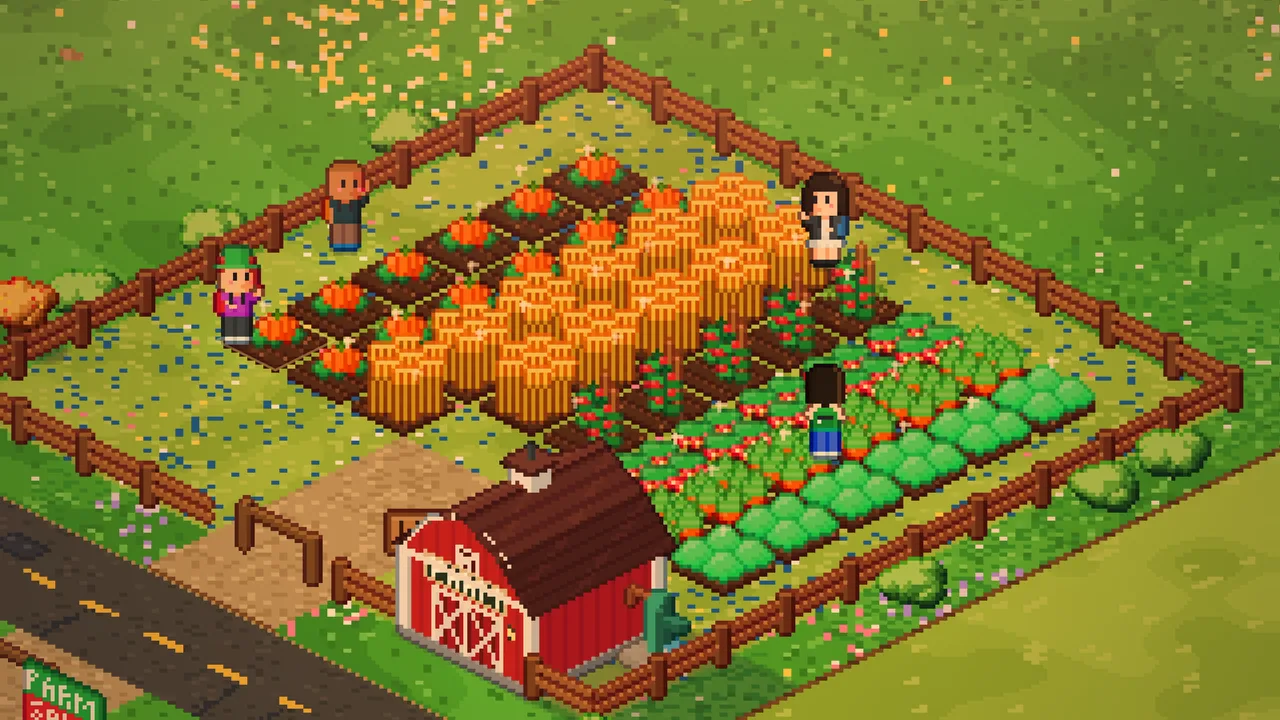
Farming is one of the calmest ways to make money in Towneers, a free browser farming game wrapped inside a multiplayer life sim. You work at your own pace, crops keep growing while you are away, and a good harvest is something other players will actually pay for. This guide goes deeper than the short page How to earn on a farm: numbers, quality, selling and mistakes.
Time in the field: the one number to remember
One game minute is one real second, so a game day lasts 24 real minutes. All growth times below are shown in real minutes at the current city settings.
1. Get a plot and build the farm
Farm plots are in North Farms on the outskirts, a short bus ride from the square. Look for a FARM SALE sign. A farm plot costs 🪙2,700–5,400 right now, much less than land in town. Plots come in 10×5 and 10×10 sizes: the smaller one is enough to learn on, the bigger one is for a real holding. You can own up to 4 plots in total, but the daily co-op quota stays one per farmer.
After buying, start the “Farm” project: a red barn (storage, seed cabinet, co-op desk, workers, journal), a water pump and a fence with a gate. More about land in Your plot and house.
2. Tools and supplies
- Hoe
- Watering can
- Fertilizer
- Steel hoe
- Big watering can
- Hoe ( 🪙8 in the shop) turns meadow into a bed. Sometimes a worm crawls out — fishing bait.
- Watering can ( 🪙15) holds 10 pours; refill at the pump. Mechanics craft a big can (Mechanic skill 45): 25 pours, and it waters three beds in a row. A steel hoe (Mechanic skill 25) tills one and a half times faster.
- Fertilizer: +15 fertility, growth ×1.25, +1 to yield. Compost (+25 fertility) comes from weeds in a compost bin. Vermicompost (Farming 75) gives +30 fertility, growth ×1.25 and +1 yield. Mulch slows drying by 40% and keeps weeds down.
- Yard objects: pump 🪙300, sprinkler 🪙70 (waters a 3×3 area), scarecrow 🪙45 (scares crows within 3 cells), yard lamp 🪙55, compost bin 🪙120.
A sprinkler or two is the best early purchase: watering is the part of the job that eats the most time.
3. All nine crops
Crops open with your Farming skill. The skill rises as you work and also adds +1 yield for every 75 points. Yield is per harvest.
| Crop | Skill | Grows | Yield | City price per ★ | Daily quota |
|---|---|---|---|---|---|
| Potatoes | 1 | 6 min | 4–6 | 🪙1.0 | 100 |
| Cabbage | 1 | 3 min | 3–5 | 🪙1.2 | 100 |
| Carrots | 5 | 7 min | 4–6 | 🪙1.0 | 100 |
| Tomatoes | 15 | 10 min, then 4 min | 3–5 × 3 harvests | 🪙1.2 | 80 |
| Peas | 20 | 8 min | 4–5 | 🪙1.0 | 80 |
| Wheat | 30 | 9 min | 6–8 (+1–2 straw) | 🪙0.55 | 120 |
| Onions | 45 | 8 min | 4–6 | 🪙1.1 | 80 |
| Strawberries | 60 | 12 min, then 6 min | 3–5 × 4 harvests | 🪙2.2 | 50 |
| Pumpkin | 120 | 24 min | 2–3 | 🪙5.5 | 20 |
Tomatoes and strawberries fruit again after the first harvest, so you replant them less often. Pumpkins pay the most per piece but take a full game day. Cabbage is the fastest turnaround for a beginner.
Warm crops (tomatoes, strawberries, pumpkin) grow 15% faster in warm weather and 20% slower in the cold; cool crops (cabbage, peas) like cool weather. Rarely, good varieties produce a curiosity: blue potatoes, a black tomato, sweet red onion or golden wheat. The cap is 8 per game day per farmer, and they are worth far more than a regular crop.
4. Seed tiers and genes
There are five seed tiers, and the tier decides which Farming skill you need:
| Tier | Name | Farming skill |
|---|---|---|
| 1 | Common | 0 |
| 2 | Improved | 25 |
| 3 | Select | 75 |
| 4 | Elite | 150 |
| 5 | Heirloom | 225 |
Every variety has three genes from 1 to 5, shown as Y, S and Q:
- Y — yield: harvest ×(1 + 0.12 per point above 1).
- S — speed: growing time shortened by 7% per point above 1.
- Q — quality: 10 care points per point at planting, up to 50.
The tier is the sum of the genes. Plain seeds cost 🪙1–4; higher tiers cost proportionally more (×4, ×12, ×30, ×80). In the barn, a seed tray station (Farming 50) grows seedlings that start 30% grown, and the breeding bench in the Big Barn (Farming 75) lets you work on your own varieties.
5. Growth: water, weeds, fertility
Every bed has moisture, fertility and weeds, and they decide growth speed.
- Moisture: at 40 or more the plant grows at full speed; 20–39 slows it to 70%; 1–19 to 30%; at 0 it wilts. A wilted bed dies after one game day of your presence. Rain and sprinklers water for you. Moisture drops faster in heat.
- Fertility: a new bed starts at 60. Under 30 you lose 1 yield and growth is 15% slower; at 70 or more you gain +1 yield. Every harvest drains fertility (pumpkin −20, tomato −18, strawberry −15, potato −12, carrot, cabbage, wheat and onion −8). Peas give +20 back. An empty bed slowly recovers by itself, up to 70.
- Crop rotation: the same plant family twice in a row drains the soil and attracts bugs. Rotate roots, leafy crops, grains and legumes.
- Weeds slow growth to 90%, 75% and 50% at levels 1, 2 and 3. Pull them: weeds make compost.
- Bugs stop growth until you catch them in a quick mini-game; crows eat the crop unless a scarecrow is nearby.
The action button picks the most urgent job near you: a peak harvest first, then bugs, crows, harvest, water, weeds. On a phone it is the big ✋.
6. Quality: how to reach ★★★
Quality stars come from care points (0–100) collected during the whole growth cycle:
| Source | Points |
|---|---|
| Q gene of the seeds | 10 × Q |
| Fertility when planting | fertility ÷ 5 (up to 20) |
| Fertilizer / vermicompost | +5 / +10 |
| Harvest at the peak (golden sparkles) | +10 |
| Wilting | −15 |
| Weeds level 2 / 3 | −5 / −10 |
| Bugs left for an hour | −15 |
| Overripe | −10 per step |
At harvest the game rolls the stars. ★★ needs decent care; ★★★ needs enough care and Farming skill 25 or more. A newcomer without fertilizer gets about three quarters ★ and a quarter ★★; an experienced farmer with high-Q seeds, vermicompost and 300 skill gets roughly a third ★★★. These stars are not cosmetic: the city pays ×1.15 for ★★ and ×1.3 for ★★★ on top of the base price, and café orders ask for stars. Players pay even more.
The sparkles matter. A crop is at its peak for a quarter of its growing time (at least one game hour). Harvest in the sparkles for +10 care points. Waiting longer costs quality, and after at least a game day of waiting the crop rots. Quick consecutive harvests also build a combo: from the third pick in a row (each within 20 seconds of the last) the experience multiplies, up to ×10.
7. Where to sell
| Channel | How it works | Best for |
|---|---|---|
| City kitchens | Cafés, pizzerias, bakeries and restaurants buy ★ crops from your barn storage on their own, at 95% of the co-op price | Passive income |
| Co-op | Sell from the barn window or straight from your bag. Full price up to the daily quota; the next quota-worth falls from 100% to 40%; the next to 25%; then it stops until the next game day | Bulk, fast cash |
| Café orders | Open the board (O, or the 📋 on the farm window), “Farming” tab: what, how many, minimum stars, deadline. Newcomers get small orders, 10–15 pieces. ★★ and ★★★ pay clearly more, plus a delivery bonus | Best price per piece |
| Players | List your ★★★ crops and curiosities in the Trading House or fill someone’s buy order | Top quality, rarities |
The quota is per crop and per farmer, not per plot. Growing three or four crops is therefore better than a field of potatoes. Only crops grown on your own farm can be sold this way; grocery stores do not buy farm produce. The farm window’s “Takings” tab shows income by day.
8. Cooking with your crops
Crops are ingredients, and cooked food sells for more than raw crops. A few simple recipes:
- Vegetable stew — potato, carrot, onion (Cooking 20).
- Pea soup — 2 peas, potato, onion (Cooking 35).
- Pumpkin pie — pumpkin, flour, sugar (Cooking 60).
- Berry tart — 2 strawberries, flour, sugar, egg (Cooking 55).
- Fries — one potato on the grill (Cooking 1).
- Pizza needs tomato, cheese and flour; goulash needs meat, potato and tomato.
- In the Big Barn: sauerkraut (4 cabbage, spices; Farming 20) in pickle barrels, pickles (carrot, cabbage, onion; Farming 40), and flour in the millstone (2 wheat give 3 flour; Farming 30).
- Curiosities unlock signature dishes such as Golden harvest pie (golden wheat, 2 strawberries, flour, sugar) or Black tomato soup.
Cooking happens in the “🛠️ Crafting” window, and recipes accept crops of any quality.
9. A day-plan for a beginner farm
| When | What to do |
|---|---|
| Start | Buy a plot, build the “Farm”, take a hoe, a can, seeds and 1–2 sprinklers |
| First hour | Till a few beds, plant cabbage and potatoes, water, learn the sparkles |
| Every visit | Check moisture, pull weeds, catch bugs, refill the can |
| When ripe | Harvest in the sparkles, replant a different family |
| Daily | Sell up to the quota of each crop, take 1–2 café orders |
| Skill 15–30 | Add tomatoes, peas and wheat; fertilize |
| Skill 25+ | Build the Big Barn (🪙2,000) and add stations; hire farmhands |
| Skill 60+ | Strawberries |
| Skill 120+ | Pumpkins, Select seeds, vermicompost |
Farmhands cost 🪙6 per hour and water, harvest and replant on their own, working 6:00–20:00. A 5×5 garden holds 2 hands, a plot up to 10×5 holds 3, and a bigger one 4.
10. Mistakes to avoid
- Planting one crop everywhere. The quota runs out and the soil wears down.
- Letting a ripe bed stand. Missed sparkles cost care points and quality.
- Skipping fertility. Under 30 the yield and speed drop.
- Ignoring bugs and crows. Bugs stop growth, and a scarecrow costs only 🪙45.
- Hand-watering a large field. Buy sprinklers or hire farmhands.
- Selling everything to the co-op. Keep ★★★ and curiosities for café orders and players.
- Replanting the same family. Rotate, and sow peas to restore fertility.
Questions and answers
How do I start farming in Towneers?
Buy a farm plot in North Farms, build the “Farm” project, get a hoe, a watering can and seeds, and till a meadow bed. The short version is on How to earn on a farm.
How much does a farm plot cost?
🪙2,700–5,400 right now. It depends on the size, and you can own up to 4 plots.
Which crop is best for a beginner?
Cabbage and potatoes: available from skill 1, quick, and cheap to grow. Carrots open at skill 5.
What is the most profitable crop?
Pumpkin pays the most per piece (🪙5.5) but needs skill 120 and a full game day. Strawberries (🪙2.2) with four harvests are a good middle step.
How do I get three-star crops?
Plant seeds with a high Q gene, fertilize, keep the bed watered and weed-free, and harvest in the golden sparkles. ★★★ also needs Farming skill 25.
Do crops grow while I am offline?
Yes, they always grow. Bad things such as wilting, rot, weeds and bugs only count while you are in the game, so a field survives at least a game day unattended.
How often do I need to water?
Moisture drops by about 6 per game hour, faster in heat. A can holds 10 pours; sprinklers or farmhands remove the chore.
Where is the best place to sell crops?
Mix them: kitchens and the co-op for volume, café orders for ★★ and ★★★, the Trading House for curiosities and top quality.
What is the co-op daily quota?
Each crop has a daily amount sold at full price: 100 for potatoes, cabbage and carrots, down to 20 for pumpkins. Beyond it the price falls, and then buying stops until the next game day.
Can I hire workers?
Yes, residents work as farmhands for 🪙6 per hour: 2 on a small garden, 3 up to 10×5, 4 on bigger plots.
Can I cook with crops?
Yes: stew, pea soup, pumpkin pie, berry tart, pizza and more. Cooking lifts the value well above raw crops.
Is it free to play?
Yes, the whole farm cycle works without paying. Gems are only for optional extras such as a barn paint job.
A cozy farm and a living player economy are what make Towneers different: your carrots can end up in someone else’s soup. See you in North Farms!